Whether you are living with anxiety, recovering from trauma, managing a neurological condition, or simply looking to sharpen your focus and mental performance, neurofeedback therapy is attracting growing interest across Australia. But what exactly is it, does the evidence support it, and is it right for you?
This guide covers everything you need to know — from how neurofeedback works, to what conditions it may help, to how to access it in Melbourne.
What is neurofeedback therapy?
Neurofeedback — also known as EEG biofeedback or neurotherapy — is a non-invasive, drug-free brain training technique. It uses real-time monitoring of your brainwave activity to help your brain learn to self-regulate more effectively.
Small sensors placed on your scalp measure electrical activity in the brain. That data is fed into software that translates your brainwave patterns into on-screen feedback — typically a video, game, or audio signal. When your brain produces targeted, healthy patterns, the feedback rewards you (the video plays smoothly). When it drifts off target, the feedback pauses — prompting the brain to self-correct.
| Over repeated sessions, the brain learns to sustain healthier activity patterns on its own — a process grounded in neuroplasticity, the brain's lifelong ability to change and adapt. |
How does a neurofeedback session work?
A typical course of neurofeedback involves the following steps:
| Initial consultation: Your practitioner takes a detailed history of your symptoms, goals, and health background. |
| Brain mapping (qEEG): Many clinics offer a quantitative EEG to identify which areas of your brain show dysregulated activity before designing your protocol. |
| Training sessions: Sessions typically run 30–60 minutes. You sit comfortably while wearing a lightweight sensor cap, watching a screen or listening to audio feedback. No effort is required — the brain responds automatically. |
| Course length: Most protocols involve 20–40 sessions. Progress is monitored and protocols are adjusted as your brain responds. |
Conditions neurofeedback may help
Neurofeedback has been studied and clinically applied across a wide range of conditions in adults:
| 😟Anxiety & stress - Calming overactive high-frequency brainwave patterns linked to chronic worry |
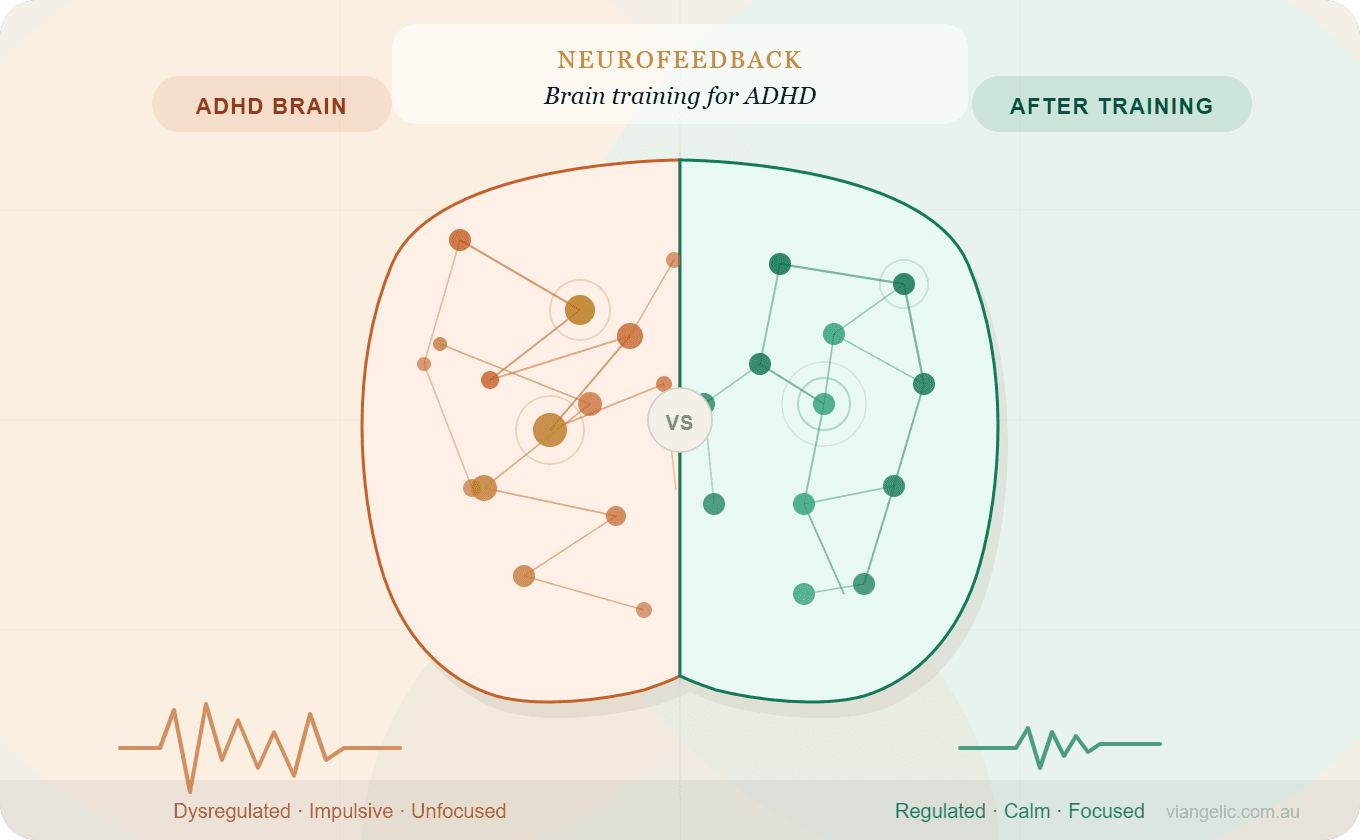
| 🌩️ADHD - Improving focus, impulse control, and working memory in adults |
| 🛡️PTSD & trauma - Reducing hypervigilance and emotional dysregulation following trauma |
| 🛏️Sleep disorders - Training brainwave patterns associated with deeper, more restorative sleep |
| 😔Depression - Targeting frontal lobe asymmetry patterns associated with low mood |
| 📈Peak performance - Optimising focus and mental clarity for executives, athletes, and students |
| 🧠Acquired brain injury - Supporting cognitive recovery following stroke, TBI, or concussion |
| 💊Chronic pain - Modulating central sensitisation patterns that contribute to persistent pain |
What does the research say?
Neurofeedback has a research history spanning more than 50 years. The evidence base is strongest for ADHD, where multiple randomised controlled trials and meta-analyses have demonstrated significant improvements in attention and impulsivity. For anxiety, PTSD, and sleep disorders, a growing body of peer-reviewed literature supports its use, particularly when delivered alongside other evidence-based therapies.
For conditions such as depression, chronic pain, and acquired brain injury, the evidence is promising but more preliminary — research is ongoing.
| In 2026, neurofeedback is increasingly recognised by Australian allied health professionals as a legitimate complementary therapy — not a replacement for proven treatments, but a meaningful addition to an integrated care plan. |
Benefits vs. limitations
Potential benefits
✓ Non-invasive and drug-free: No medication, no needles, no downtime — suitable for those seeking alternatives or complements to pharmacological treatment.
✓ Long-lasting results: Unlike medication, improvements from neurofeedback training tend to persist after the program ends.
✓ Highly personalised: Protocols are tailored to your individual brainwave profile, not a one-size-fits-all approach.
✓ Minimal side effects: Most people experience no adverse effects. Some report mild, temporary fatigue after early sessions as the brain adapts.
Limitations to consider
✓ Commitment required: Results are cumulative — attending only a handful of sessions is unlikely to produce lasting change.
✓ Out-of-pocket cost: Neurofeedback is not currently covered by Medicare or private health insurance in most cases. It is an out-of-pocket investment.
✓ Variable provider quality: There is no single national certification standard in Australia. Choosing a qualified, experienced practitioner is essential.
Understanding the cost
Neurofeedback is a private-pay service in Australia. Costs vary between clinics, but as a general guide:
| Initial assessment / qEEG brain map — $200 – $400 |
| Individual session (30–60 min) — $100 – $250 per session |
| Typical full program (20–40 sessions) — $2,000 – $8,000+ |
| Medicare / NDIS rebate — Not currently available |
How to choose a provider in Melbourne
When searching for neurofeedback therapy near you in Melbourne, look for practitioners who:
✅ Hold AHPRA registration or membership with a recognised professional body (psychology, occupational therapy, or neurofeedback credentialling)
✅ Offer an initial assessment or qEEG brain map before commencing treatment
✅ Use certified, clinical-grade equipment and evidence-based protocols
✅ Are transparent about expected outcomes, session numbers, and total cost upfront
Frequently asked questions
1.Is neurofeedback therapy safe for adults?
Yes. Neurofeedback is non-invasive — the sensors only read brainwave activity and do not deliver any electrical current. It is considered safe for most adults. Your practitioner will screen for any contraindications at your initial consultation.
2.How long before I notice results?
Some people notice subtle changes within the first 5–10 sessions — improved sleep, clearer thinking, or reduced reactivity. More significant, lasting changes typically emerge after 20–30 sessions. Results vary depending on the condition being addressed and individual neurological differences
3.What does a neurofeedback session feel like?
Most people find sessions relaxing. You sit comfortably, wear a lightweight sensor cap, and watch a screen or listen to audio. You do not need to concentrate or actively do anything — the brain responds to the feedback automatically. There is no pain or discomfort involved.
4.Can I do neurofeedback alongside medication or other therapy?
Yes. Neurofeedback is commonly used alongside medication, psychology, occupational therapy, and other supports — it often works best as part of an integrated care plan. Always inform your prescribing doctor, as some people find they require medication adjustments as their symptoms improve.
5.Is neurofeedback covered by Medicare or private health insurance?
Neurofeedback is not currently covered by Medicare. Some private health insurers may provide a partial rebate under extras cover depending on the practitioner's registration and your specific policy — it is worth checking directly with your insurer before commencing treatment.
Need NDIS Support?
Viangelic is a registered NDIS provider helping people across Melbourne and Sydney — including Vietnamese-speaking participants.