Expert, culturally sensitive NDIS services for the Vietnamese community in Victoria — helping individuals with cerebral palsy live the life they choose, in the language of their heart
What Can the NDIS Fund for Cerebral Palsy?
Cerebral palsy (CP) is a permanent neurological condition affecting movement, muscle tone, and posture. Because it is recognised as a permanent disability under the NDIS, most people with CP qualify for funded support — often from birth or early childhood.
The NDIS takes a goal-oriented, whole-of-life approach, meaning your plan is built around what you want to achieve — independence, communication, education, employment, or community participation — not just your medical diagnosis.
The NDIS can fund support across three categories: everyday activities (Core), building skills and independence (Capacity Building), and equipment and home modifications (Capital).
Core Supports
Everyday assistance that helps participants live and participate in their community:
🧑🦽Personal Care - Bathing, dressing, grooming, eating assistance, and continence support tailored to individual needs.
🏠 Daily Living Assistance - Cooking, cleaning, shopping, and household tasks to maintain a safe, comfortable home environment.
🚗 Transport & Mobility - Supported travel to therapy, school, work, medical appointments and community activities.
👥 Community Access - Support to engage in social, recreational, and cultural activities — including Vietnamese community events.
Capacity Building Supports
Therapeutic services that build long-term skills and independence. For people with cerebral palsy, these are often the most impactful supports in a plan:
💪 Physiotherapy - Improving strength, balance, gait, and preventing contractures and deformities. Includes hydrotherapy and gym-based rehab.
🖐️ **Occupational Therapy - **Developing fine motor skills, self-care routines, school participation, and recommending assistive equipment.
🗣️ Speech Pathology - Communication skills, AAC (augmentative and alternative communication) devices, swallowing safety, and literacy.
🧠 Psychology & Behaviour Support- Mental health, self-confidence, social skills, and behaviour support plans for complex needs.
📋 Support Coordination - Help connecting with providers, managing your plan, and navigating the NDIS system in Vietnamese.
🎯Early Childhood Support - For children under 7, early intervention therapy delivered immediately after diagnosis — when outcomes are best.
Capital Supports
Higher-cost items and home modifications that provide long-term benefit:
Manual and powered wheelchairs, custom seating and positioning systems
Ankle-foot orthoses (AFOs), hand splints, and other orthotics
Home modifications — ramps, grab rails, ceiling hoists, accessible bathrooms
Vehicle modifications for safe school and community transport
Standing frames, gait trainers, therapeutic equipment for home use
Are You Eligible for NDIS Funding?
Cerebral palsy is listed as a diagnosed condition under the NDIS, which means the access process is typically straightforward. You generally do not need extensive functional assessments — a confirmed diagnosis from a neurologist or paediatrician is usually sufficient.
To be eligible, you or your child must meet all of the following:
Under 65 years of age at the time of first application
Be an Australian citizen, permanent resident, or hold a Protected Special Category Visa
Have cerebral palsy confirmed by a medical specialist (GP referral for paediatric neurologist is the usual pathway)
The condition significantly reduces ability to participate in everyday activities
Require support that would not otherwise be available
Cerebral palsy does not get better over time — it is permanent. This actually simplifies NDIS access, as you don't need to prove ongoing deterioration.
For children under 7, the NDIS Early Childhood Approach means you can access funded therapy immediately after diagnosis through an Early Childhood Partner — without waiting for a full NDIS plan to be approved.
How to Apply — Step by Step
Viangelic supports Vietnamese families through every step of the process, from the first phone call to receiving your first funded services.
01. Contact Viangelic or the NDIS directly - Call us on 0483 223 662 for Vietnamese-language support, or call the NDIS on 1800 800 110
02. Gather supporting medical evidence - Obtain a detailed diagnosis letter from your neurologist or paediatrician. Ask all allied health professionals (physiotherapist, OT, speech pathologist) to write functional impact reports describing how CP affects daily life — not just the diagnosis.
03. Submit the Access Request Form - Complete the NDIS Access Request Form online or by phone. For children under 7, contact your local Early Childhood Partner instead. Viangelic can assist you in completing all paperwork in Vietnamese.
04. Attend your planning meeting - Once access is approved, you'll meet with an NDIS planner or Local Area Coordinator. Bring a list of goals and current needs. Viangelic can attend with you to ensure your plan reflects your real needs — and is funded appropriately.
05. Receive your plan and begin services - Your approved plan outlines your funding categories and amounts. Viangelic connects you with registered providers and helps you get started. Plans are reviewed annually and can be adjusted as needs change.
Why Vietnamese Families Choose VIANGELIC?
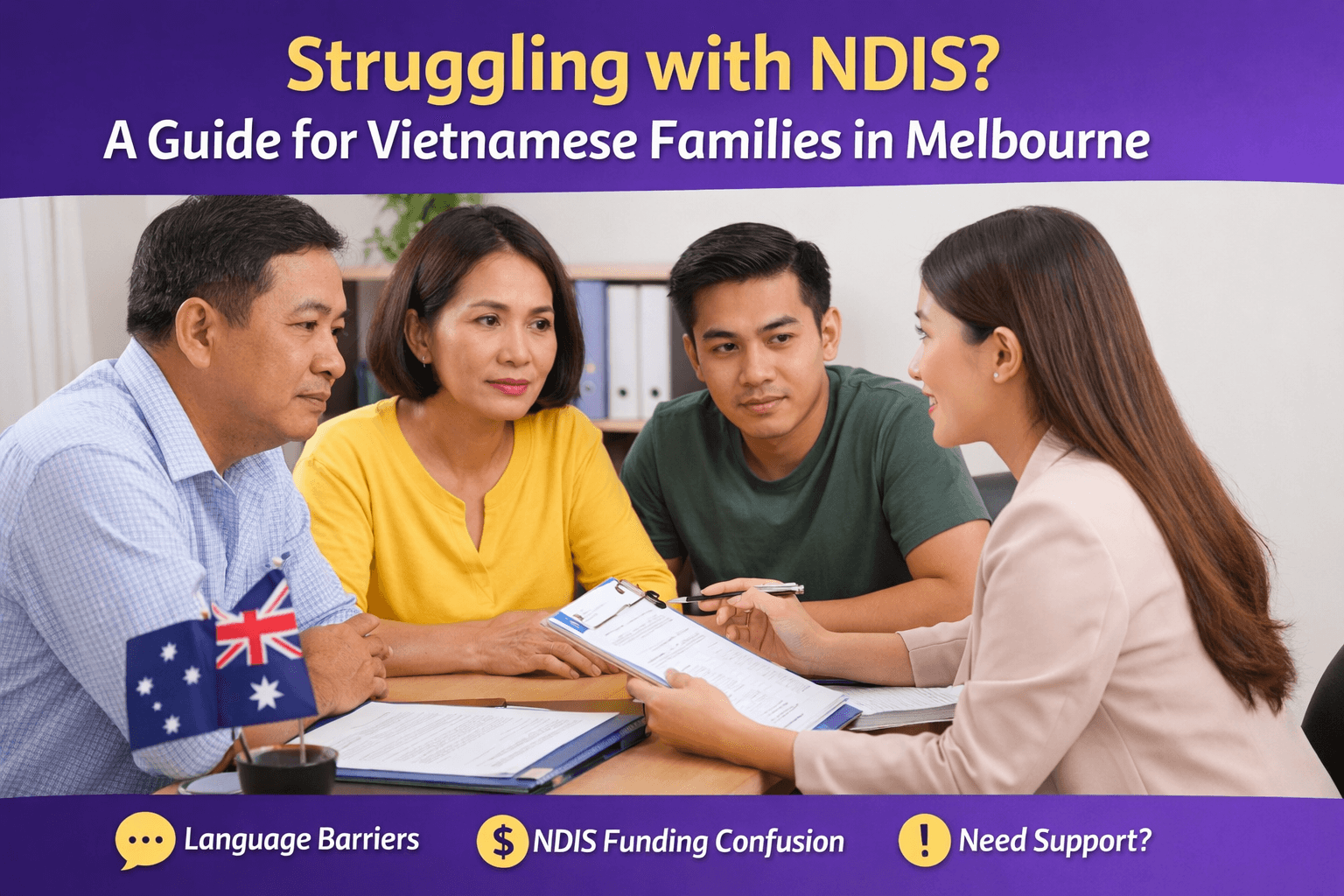
Navigating the NDIS is complex for anyone — but for Vietnamese-speaking families, language barriers, cultural differences, and unfamiliarity with the Australian disability system can create additional obstacles that mean families miss out on support their children are entitled to.