Home Care Support for Cerebral Palsy: What Families Really Need
2026-05-0815 min readViangelic Team
Why Home Care Matters Most
For children with cerebral palsy, home is not simply an address — it is the centre of their world. The specialist clinic is visited once a month. The therapy room, twice a week. School fills term-time hours. But home is constant — and what happens there, every single day, shapes a child's quality of life, development, and sense of belonging more profoundly than any clinical setting.
Yet for most families, home is also where support is most absent. Professionals come with defined roles and leave at the end of the session. The rest falls entirely on parents, grandparents, and carers — often without training, adequate equipment, or any time to rest. The gap between what is needed at home and what is provided is one of the most significant unmet challenges in disability care across Australia.
For Vietnamese-Australian families, this challenge is often amplified by language barriers, unfamiliarity with Australia's disability system, and cultural expectations around keeping care within the family. The NDIS exists to bridge exactly this gap — but only when families know how to access it, and in their own language.
Vietnamese Families, Disability & the NDIS
Gia đình Việt Nam, khuyết tật và NDIS
Australia is home to more than 330,000 people of Vietnamese heritage — concentrated significantly in Melbourne, Sydney, Brisbane, Adelaide, and Perth. Vietnamese-Australian communities bring deeply held values around family responsibility, filial piety, and collective care that shape how disability is experienced and how help is sought.
Cultural Insight - In many Vietnamese families, a child's disability may be associated with stigma, spiritual beliefs, or a private sense of shame — feelings that make it difficult to discuss openly or seek help outside the family. These feelings are understandable, and they are shared by many families across cultures. Acknowledging them without judgment is the first step toward accessing the support your child deserves.
The NDIS has no equivalent in Vietnam, and its concepts — individualised plans, funded support workers in the home, participant choice and control — can feel unfamiliar at first. This is entirely normal. Navigating any new system takes time, and Vietnamese-speaking supports exist at every step.
✓ You have the right to a free interpreter for all NDIS conversations
✓ All NDIS planning meetings can be conducted with a Vietnamese interpreter present at no cost to you
✓ You can specifically request Vietnamese-speaking support workers, planners, and coordinators
✓ Your extended family structure — grandparents, aunts, uncles — can and should be reflected in your child's NDIS plan
✓ You can bring a trusted community member or advocate to any NDIS meeting
What Families Really Need at Home
Những gì gia đình thực sự cần tại nhà
When Vietnamese-Australian families are asked what would most change their lives, the answers are remarkably specific and consistent. They are not asking for miracles. They are asking for enough — enough rest, enough help, enough support to care for their child without breaking themselves in the process.
😴 Sleep & Rest - Overnight support workers so exhausted carers — often elderly grandparents or sole parents — can sleep safely through the night.
🗣️ Support in Vietnamese - Workers who speak Vietnamese, understand family structures, and communicate effectively with grandparents and extended family.
🛁 Personal Care Help - Skilled daily assistance with bathing, dressing, and feeding — reducing the morning and evening physical load on primary carers.
🏠 A Safe Home - Hoists, ramps, and bathroom modifications that make the home safe for a growing child — and prevent carer injury.
📋 System Navigation - A bilingual Support Coordinator who understands both the NDIS and Vietnamese family values — and advocates for the family effectively.
🤝 Community Connection - Other Vietnamese families raising children with disability — the profound relief of being truly understood by someone who lives it too.
Personal Care & Daily Routines
Chăm sóc cá nhân và thói quen hàng ngày
For many children with cerebral palsy, the morning routine alone — showering, dressing, positioning, eating — can take one to two hours and requires significant physical assistance. When this falls entirely on a single parent or elderly grandparent, day after day without relief, the physical toll becomes severe.
✓ Showering and bathing using accessible equipment and safe positioning techniques
✓ Dressing and undressing, including applying orthotics and splints
✓ Mealtime assistance and feeding support, including for children with swallowing difficulties
✓ Oral hygiene, skincare, and pressure area management
✓ Safe transfers and repositioning — particularly vital for older Vietnamese grandparent carers
✓ Communication support for children using AAC devices during daily routines
✓ Medication assistance under appropriate supervision
What bilingual NDIS support looks like in practice
🗣️ Vietnamese-speaking support workers (Nhân viên hỗ trợ nói tiếng Việt)
📋Bilingual support coordinators (Điều phối viên hỗ trợ song ngữ)
🏥Vietnamese allied health therapists (Chuyên gia y tế đồng minh tiếng Việt)
📞 NDIS planning with free interpreter (Lập kế hoạch NDIS với phiên dịch miễn phí)
📚 NDIS documents in Vietnamese (Tài liệu NDIS bằng tiếng Việt)
🤝Vietnamese community advocates (Người vận động cộng đồng người Việt)
🏠 Culturally safe in-home care (Chăm sóc tại nhà phù hợp văn hóa)
👨👩👧 Family-centred NDIS planning (Lập kế hoạch NDIS lấy gia đình làm trung tâm)
VIETNAMESE NDIS SERVICE · DỊCH VỤ NDIS TIẾNG VIỆT
Finding Vietnamese NDIS Support Workers
Tìm nhân viên hỗ trợ NDIS nói tiếng Việt
Families can request culturally and linguistically appropriate support workers under the NDIS — including workers who speak Vietnamese. This is not simply a preference: for Vietnamese-Australian families where grandparents are primary carers or where English is a second language, a Vietnamese-speaking worker provides fundamentally better, safer care.
What Vietnamese NDIS Support Workers Can Provide
🗣️ Direct communication in Vietnamese with child, grandparents & family
🍚 Culturally appropriate mealtime support & food preparation
👨👩👧 Respect for extended family roles and household dynamics
🏥 Translation bridge between family and medical/therapy teams
📋 Help completing Vietnamese-language NDIS paperwork
🧘 Cultural sensitivity around disability, privacy & family honour
What to look for in any support worker — especially bilingual ones
**01. Vietnamese language proficiency **
Able to communicate naturally with your child, grandparents, and extended family — not just basic phrases.
02. CP-specific knowledge
Training or clear experience in supporting children with cerebral palsy — safe handling, positioning, communication support, therapy reinforcement.
03. Valid NDIS checks
NDIS Worker Screening Check, Working with Children Check, and current First Aid. Non-negotiable regardless of language skills.
04. Cultural understanding
Genuine familiarity with Vietnamese family structures, respect for elders, and sensitivity around disability and privacy.
05. Reliability & consistency
Shows up on time, every time, and has clear backup protocols — because a missing worker disrupts the entire family's day.
Home Modifications & Specialised Equipment
Many Vietnamese-Australian families live in homes — often shared with multiple generations — that were not designed for a child with significant physical needs. Narrow hallways, bathroom steps, and multi-storey layouts make daily care more dangerous and exhausting than it needs to be. The NDIS funds modifications to change this under the Capital Supports budget.
✓ Ceiling hoists — eliminates manual lifting between rooms; protects older carers' backs and joints
✓ Doorway widening — for wheelchairs, walking frames, and hoisting equipment
✓ Specialised beds — height-adjustable, pressure mattresses, bed rails and positioning aids
✓ Smart home technology — voice-controlled lights, heating, devices for children with limited hand function
In-Home Therapy for Children with CP
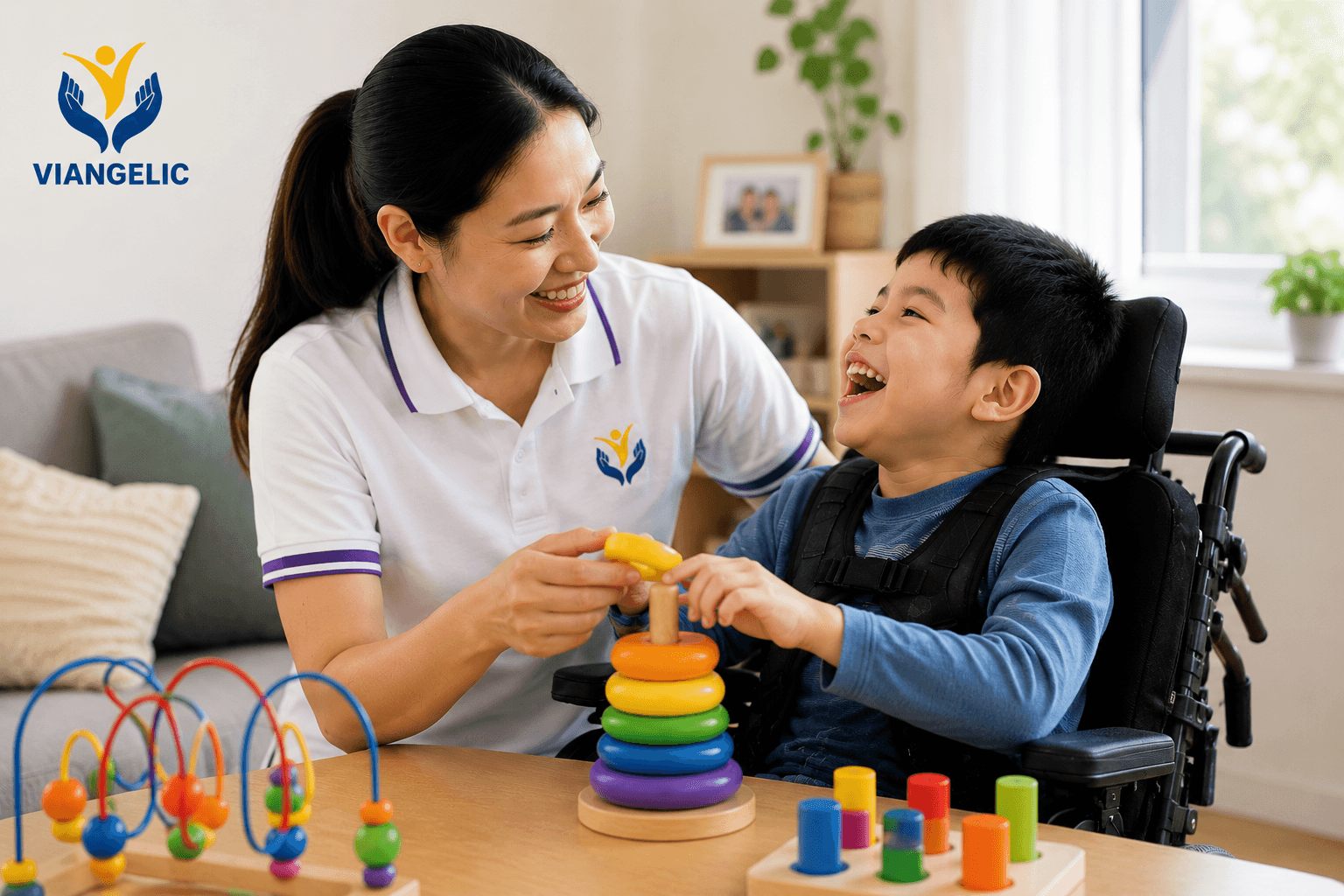
Allied health therapists can deliver physiotherapy, occupational therapy, and speech pathology directly in the home. For Vietnamese families, this is particularly valuable — therapy happens in the real environment, and grandparents and extended family can observe and participate in learning the strategies that help the child between sessions.
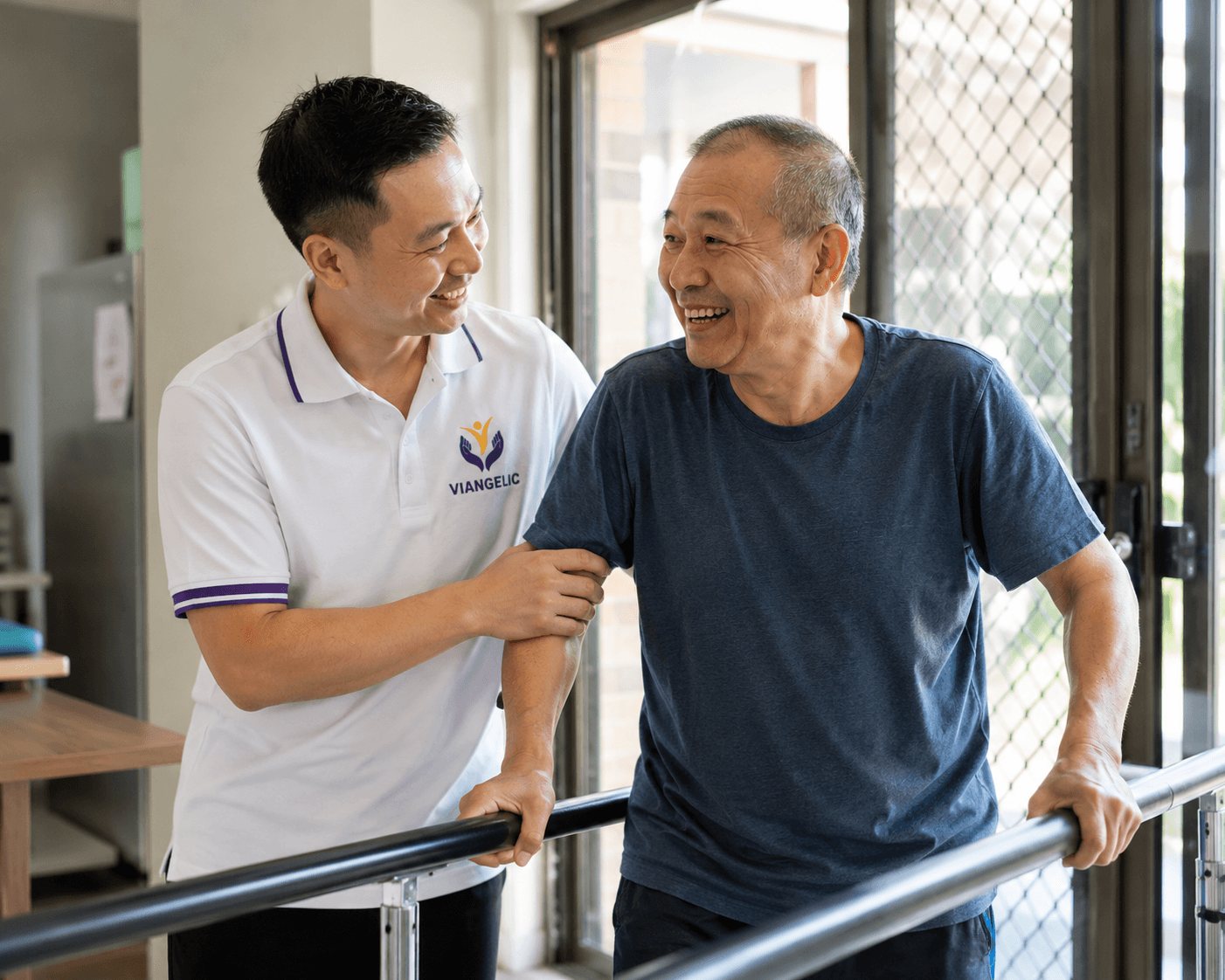
🏃 In-Home Physiotherapy - Home exercise programs taught directly to carers; mobility equipment assessment in the actual home; safe movement guidance for everyday routines.
✂️ Occupational Therapy - Observes and adapts real daily routines; prescribes assistive technology; trains grandparents and family in safe manual handling techniques.
💬 Speech Pathology - Works on communication and mealtimes in natural settings; trains the whole family — including Vietnamese-speaking grandparents — in AAC use.
WHEN YOU NEED A BREAK
Overnight & Respite Support
Hỗ trợ nghỉ ngơi và qua đêm
Many Vietnamese families feel profoundly uncomfortable asking for respite. The cultural value of keeping care within the family is strong, and accepting outside help can feel like failure or a betrayal of duty. But respite is not failure — it is essential medicine for carers. A carer who never rests becomes injured, unwell, and eventually unable to care at all.
✓ **In-home overnight support workers **— stays overnight for repositioning, seizure monitoring, or personal care; allows carers to sleep
✓ Short-Term Accommodation (STA) — NDIS-funded stays of up to 14 days; gives the entire family genuine rest
✓ In-home daytime respite — a worker attends for several hours so the primary carer can rest, attend appointments, or simply breathe
✓ Emergency respite 24/7 — through Carer Gateway (1800 422 737); access Vietnamese via TIS National 131 450
NDIS Funding for Home Care
Home care supports are funded across the NDIS's three budget categories. Understanding these — ideally with a Vietnamese-speaking Support Coordinator — is essential to building a plan that actually meets your family's needs.
Core Supports
Personal care & daily assistance
Vietnamese support workers (daytime)
Overnight & sleepover shifts
Short-term accommodation (respite)
Community access & transport
Consumables (continence, gloves)
Capacity Building
Bilingual support coordination
In-home allied health therapy
Vietnamese carer training programs
Manual handling training
Behaviour support
Plan management
Capital Supports
Ceiling hoists & transfer aids
Bathroom modifications & ramps
Specialised beds & mattresses
Wheelchairs & positioning equipment
AAC communication devices
Smart home technology
Support Coordination
Vietnamese-speaking coordinators
Sourcing bilingual workers
NDIS navigation in Vietnamese
Liaising with schools & health teams
Plan reviews & appeals support
Crisis & emergency coordination
Vietnamese NDIS Resources & Support
Tài nguyên và hỗ trợ NDIS tiếng Việt tại Úc
📞 TIS National — Free Interpreter Service 131 450 — Free phone interpreting 24/7. Call and say "Vietnamese" (tiếng Việt). Use for all NDIS calls, medical appointments, and government services.
🏛️ NDIS — National Disability Insurance Scheme 1800 800 110 · Mon–Fri 8am–8pm · Request Vietnamese interpreter at start of call. Vietnamese resources at ndis.gov.au
🤝 Cerebral Palsy Alliance 1800 888 378 · cpalliance.com.au — Bilingual support navigation, therapy, equipment, and community programs. Can connect families with Vietnamese-speaking services.
❤️ Carer Gateway — Emergency & Ongoing Support 1800 422 737 · 24/7 emergency respite · carergateway.gov.au — Access Vietnamese via TIS National 131 450. Free counselling, peer support, practical help for carers.
⚖️ NDIS Quality & Safeguards Commission 1800 035 544 · ndiscommission.gov.au — Complaints about providers or interpreter costs being deducted from plans. Vietnamese resources available.
🛡️Disability Advocacy Finder — Find a free advocate with Vietnamese language capacity. disabilityadvocacyfinder.dss.gov.au — Free, independent, and confidential.
👨👩👧 Services Australia — Carer Payment & Allowance 136 150 — Financial support for carers of people with disability. Request Vietnamese interpreter. Separate to NDIS — grandparent carers may be eligible.
📞 Contact Viangelic Today
If your family is looking for trusted and compassionate Vietnamese NDIS services in Melbourne, Viangelic is here to help.