
Raising a child with cerebral palsy is one of the most profound experiences a family can have — filled with love, fierce advocacy, hard-won milestones, and a kind of exhaustion that goes bone-deep. The joy is real. So is the challenge.
This piece does not pretend that caring for a child with CP is simply a matter of perspective, or that the right attitude makes it easy. It honours the truth: that families carry an enormous load — physical, emotional, financial, and logistical — often with very little recognition or respite. And it offers some signposts toward support.
01 Physical Demands
The Weight of Daily Physical Care
For many families, caring for a child with CP involves significant physical labour — every single day, without pause. Depending on the severity of their child's condition, parents and carers may spend hours each day assisting with tasks that other children do independently: dressing, bathing, feeding, repositioning, transferring between wheelchair and bed, and administering medications or tube feeds.
Children with more significant physical needs may require lifting and carrying that places immense strain on a carer's back, shoulders, and joints. Many parents develop chronic musculoskeletal pain over years of caregiving — often without the means or time to address it. A child's growing body means that what was manageable at age three becomes genuinely physically dangerous by age ten.
| 40+ hours per week of direct care provided by many CP families | 2x higher injury rate among primary carers of children with physical disability | Night disruptions affect up to 80% of families — sleep disorders are common in CP |
Sleep deprivation compounds everything. Many children with CP experience disrupted sleep due to pain, spasticity, seizures, or respiratory difficulties. Parents who are already physically depleted from daytime care are also consistently sleep-deprived — a combination that has serious effects on physical and mental health.
| What can help: NDIS funding for personal care support workers, manual handling training, and assistive equipment (hoists, shower chairs, positioning aids) can meaningfully reduce physical strain. Ask your occupational therapist about a home modification and equipment assessment. |
02 Emotional Wellbeing
The Emotional Weight No One Talks About
Families of children with cerebral palsy often describe a grief that is difficult to name — not grief for a child, but grief for the life they imagined, for the milestones that unfold differently, for the ordinary moments that come with quiet heartbreak attached. A first step that took three years of therapy. A birthday party where their child sat apart. A question from a sibling that has no easy answer.
This grief is real, and it coexists with profound love. Parents often feel guilty for feeling it — as if acknowledging the difficulty is somehow a betrayal of their child. It is not. Holding both love and grief at the same time is one of the most demanding emotional tasks a person can undertake.
"Nobody tells you that you can grieve and celebrate at the same time. That you can be fiercely proud of your child and devastated by what they have to go through — sometimes in the same hour. I thought something was wrong with me. There wasn't." — Father of a 12-year-old with dyskinetic CP, New South Wales
Beyond grief, families frequently report chronic anxiety — about their child's health, their future, what will happen when the parents can no longer care for them, and whether the supports they have fought for will continue. This background hum of worry is exhausting and rarely goes away entirely.
Parent burnout is not a character failing. Research consistently shows that primary carers of children with significant disabilities are at substantially elevated risk of depression, anxiety, and post-traumatic stress. Many go years without a proper break.
| What can help: Carer Gateway (1800 422 737) offers free counselling and peer support for Australian carers. The NDIS can fund respite (short-term accommodation) and in-home support, giving carers genuine time to recover. Psychology services for carers can also be accessed via a GP Mental Health Care Plan. |
03 Financial Pressure
The Financial Reality of Caring for a Child with CP
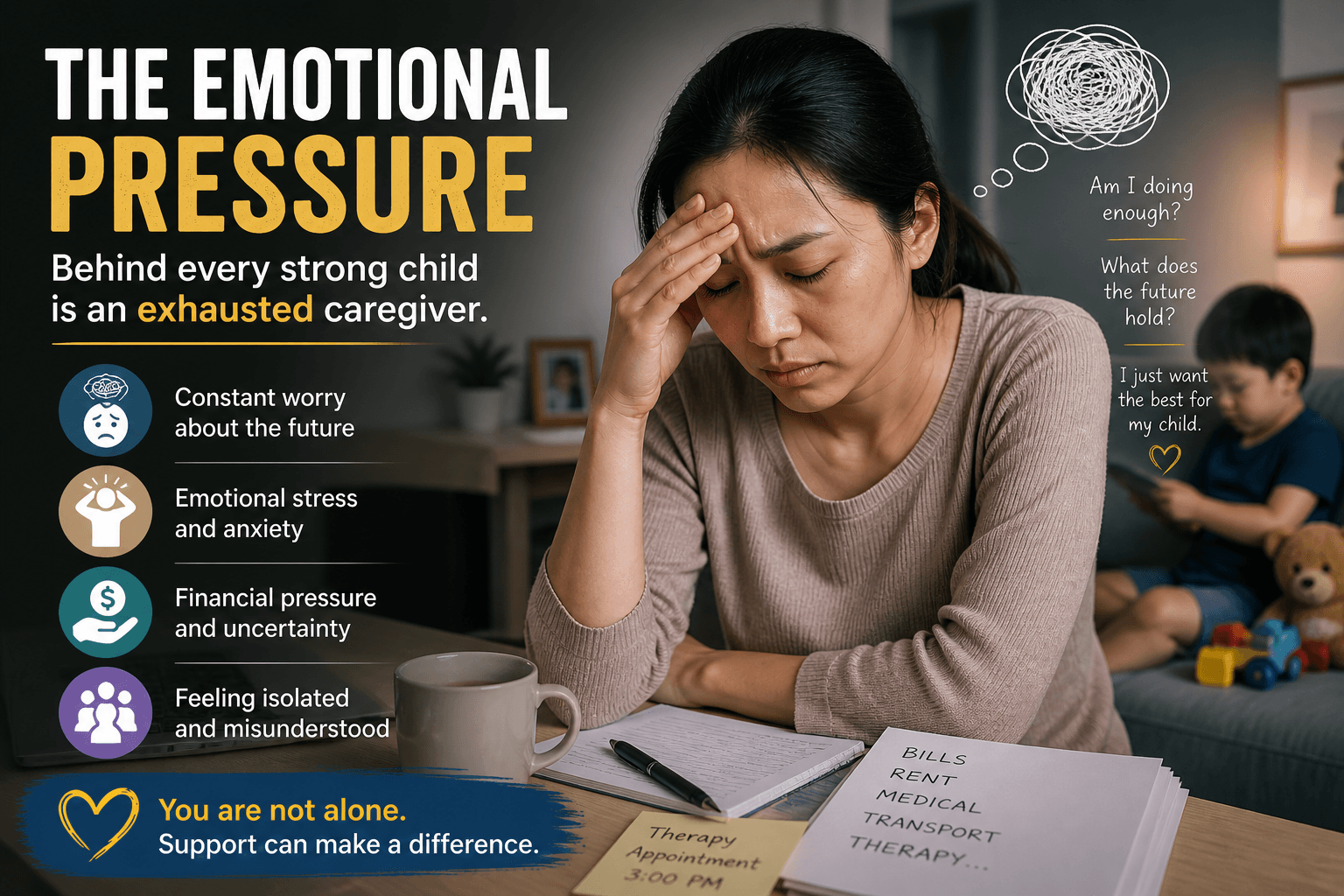
The financial cost of raising a child with cerebral palsy is substantially higher than raising a child without disability — even with NDIS support. Families frequently face a gap between what is funded and what is needed, and they fill it with their own money, time, and energy.
- Specialist medical appointments — paediatricians, neurologists, orthopaedic surgeons, ophthalmologists — many of which involve out-of-pocket costs not covered by Medicare
- Therapies that exceed NDIS plan funding — particularly when children need intensive therapy blocks or specialist programs
- Specialised equipment not approved by the NDIS, or approved after months-long delays while the family needs it now
- Home modifications (ramps, bathroom adaptations, wider doorways) that come with significant upfront costs
- Adapted vehicles or transport for wheelchair users
- Specialised foods, formula, or feeding equipment for children with complex feeding needs
- Lost income — one or both parents often reduce work hours or exit the workforce entirely to meet care needs
The income impact is one of the most significant and least visible financial pressures. Many primary carers — disproportionately mothers — find that the logistics of caring for a child with CP make sustained employment impossible without substantial in-home support. This has long-term consequences for superannuation, career trajectory, and financial independence.
| What can help: The Carer Payment and Carer Allowance (Services Australia) provide financial support for eligible carers. The NDIS covers many direct costs. Some state governments offer additional disability-specific grants. Speak with a financial counsellor experienced in disability — services like Financial Counselling Australia can help. |
04 Systems & Bureaucracy
Navigating Complex Systems While Exhausted
Caring for a child with CP often requires families to become expert navigators of multiple complex systems simultaneously: the NDIS, Medicare, the health system, the education system, specialist services, and community supports. Each system has its own language, processes, timelines, and bureaucratic demands — and none of them talk to each other particularly well.
NDIS planning alone can consume dozens of hours: gathering reports, attending meetings, appealing decisions, managing invoices, finding and vetting providers, and staying on top of plan utilisation. This is unpaid labour that falls almost entirely on families — most often on mothers.
| Dozens of hours per year spent on NDIS administration by the average CP family |
| 3–6 months typical wait for specialist paediatric appointments in many parts of Australia |
| Often years before children reach the front of waitlists for key allied health services |
Education brings its own navigation challenges. Advocating for appropriate adjustments, attending Student Support Group meetings, liaising with teachers and aides, and managing transitions between school stages all require significant parental investment. Families in rural and regional Australia face additional barriers, including fewer local specialists, longer travel times, and limited provider availability under their NDIS plans.
"I have a folder with over 400 documents in it — reports, plans, invoices, meeting notes. I never wanted to become an expert in disability bureaucracy. But here we are. You do what you have to do for your kid." — Mother of twin boys, one with spastic quadriplegia, South Australia
| What can help: A Support Coordinator (funded through the NDIS) can take on much of the system navigation, provider sourcing, and plan management burden. Disability advocacy organisations can assist with school negotiations and NDIS appeals. You do not have to manage this alone. |
05 Social Connection
Isolation — For the Child and for the Family
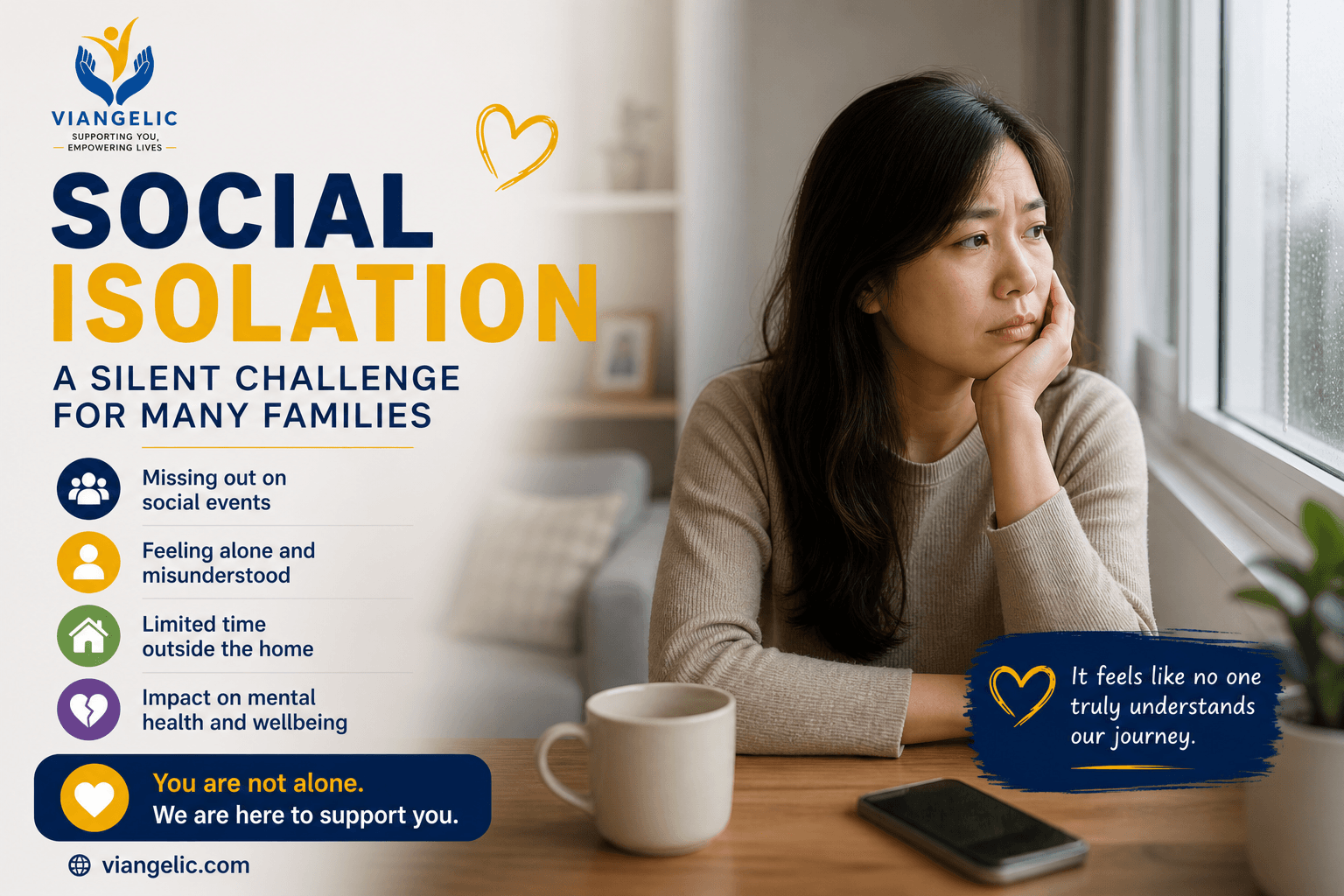
Social isolation affects many children with CP and their families in ways that are painful and cumulative. Children with physical or communication differences may struggle to form friendships in mainstream settings. Playground dynamics can be unkind; birthday party invitations may stop coming; after-school activities that other children take for granted may be inaccessible or logistically impossible.
For parents, the social world can shrink considerably. Friendships with other parents can feel strained when your child's life looks so different. Casual social events require planning and accessibility considerations. Parent groups and school communities are often built around shared experiences that don't map onto your reality. Over time, many carers report feeling profoundly alone — even when surrounded by people who love them.
- Difficulty attending mainstream social activities due to accessibility or care needs
- Staring, unhelpful comments, or unsolicited advice from strangers in public
- Friends and extended family who struggle to understand or engage meaningfully
- Partners who grieve and cope differently, creating distance in the relationship
- Reduced capacity for spontaneity — every outing requires significant planning
- Siblings who may feel overlooked or carry invisible emotional burdens
"We used to have friends. Then life just got too complicated to maintain. You stop being invited because people don't know what to say, or how to include you. And you stop reaching out because you have nothing left." — Parent, Western Australia
| What can help: Peer support groups for parents of children with CP (in person and online) can be profoundly connecting — the sense of being truly understood by someone who lives a similar life. Cerebral Palsy Alliance and Carer Gateway can connect you with peer networks. For children, NDIS-funded social skills programs and community participation supports open doors to friendship and belonging. |
06 Family Dynamics
The Impact on Siblings and Relationships
When a child has complex care needs, the ripple effects move through the whole family. Siblings of children with CP often grow up with a particular kind of complexity — they may feel overlooked, carry worry about their brother or sister, take on caring responsibilities beyond their years, and struggle with feelings they find difficult to name or express.
Many siblings develop remarkable empathy, resilience, and maturity. But they also deserve space to have needs of their own — to have a birthday that isn't overshadowed by a crisis, to have a parent present at their school concert, to simply feel like they matter equally. Families often carry guilt about this balance, even when they are doing their absolute best.
Intimate partnerships are also significantly affected. The shared stress of caring for a child with high needs — combined with financial pressure, exhaustion, and reduced time for each other — places considerable strain on relationships. Couples often grieve differently, argue about care decisions, and struggle to find the bandwidth to nurture their partnership. Relationship breakdown rates are notably higher among families of children with significant disability.
*"My other two kids are wonderful. They love their sister. But I know they've given things up that they've never said out loud. That weighs on me every day. I can only do so much." *— Parent of three, including one child with CP, ACT
| What can help: Peer support groups for parents of children with CP (in person and online) can be profoundly connecting — the sense of being truly understood by someone who lives a similar life. Cerebral Palsy Alliance and Carer Gateway can connect you with peer networks. For children, NDIS-funded social skills programs and community participation supports open doors to friendship and belonging. |
07 Looking Ahead -- Fear for the Future
One of the most persistent emotional burdens for families is fear about the future — particularly, what happens when parents are no longer able to care for their child. For children with CP who will require lifelong support, the question of long-term care, housing, employment, and relationships is ever-present.
The disability support system in Australia has improved significantly in recent years, but uncertainty remains. NDIS policies change. Funding decisions are contested. Provider quality varies. And no support worker, no matter how wonderful, replaces a parent's knowledge, love, and commitment. Families are acutely aware of this, and it generates a particular kind of anticipatory grief and anxiety that is difficult to set aside.
- Planning for supported independent living or shared living arrangements
- Establishing legal arrangements (special disability trusts, guardianship) to protect a child's future
- Thinking about employment, relationships, and community for a young person with disability
- Managing the transition from paediatric to adult services — a notoriously difficult period for families
- Ensuring continuity of support if a parent becomes ill or dies
| What can help: Estate planning with a solicitor experienced in disability law, Special Disability Trusts, and appointment of a guardian or financial administrator can provide significant peace of mind. Organisations like Cerebral Palsy Alliance offer transition planning support. The NDIS supports adults with CP across housing, employment, and community participation. |
Across All These Challenges — What Genuinely Helps
| ✓ Being believed and not having to justify your reality — by family, friends, professionals, and systems |
| ✓ Peer connection — families who understand, because they live it |
| ✓ Practical, reliable in-home support — so carers can rest, work, or just breathe |
| ✓ A Support Coordinator — who takes on system navigation so families don't have to |
| ✓ Respite — short-term, regular, and without guilt |
| ✓ Mental health support for carers — not as a luxury, but as a necessity |
| ✓ Flexible, accessible communities — schools, sports, social groups that include everyone |
| ✓ Financial counselling and planning — so that money stress doesn't compound everything else |
👉 You are not failing. You are doing something extraordinarily hard.
Caring for a child with cerebral palsy asks more of a family than most people will ever understand. If you are in the middle of it right now — exhausted, grieving, advocating, loving — know that you are seen, and that support exists. You do not have to carry this alone.
- Cerebral Palsy Alliance
- Carer Gateway · 1800 422 737
- NDIS · 1800 800 110
- Siblings Australia
Need NDIS Support?
Viangelic is a registered NDIS provider helping people across Melbourne and Sydney — including Vietnamese-speaking participants.